Creative Writing
A Cantankerous Old Man
Madison Caldwell
I asked her to tell me a little bit about him. I had met him for the first time as he underwent a rapid sequence intubation, propofol quickly pushing him into a deep sleep. And he remained in this twilight state as I walked in and out of the room, listening to his lungs, checking the ventilator settings, chatting with his wife. I had received the handoff that he was a "cantankerous" old man. Set in his ways, man of few words, a touch grumpy for lack of a better term.
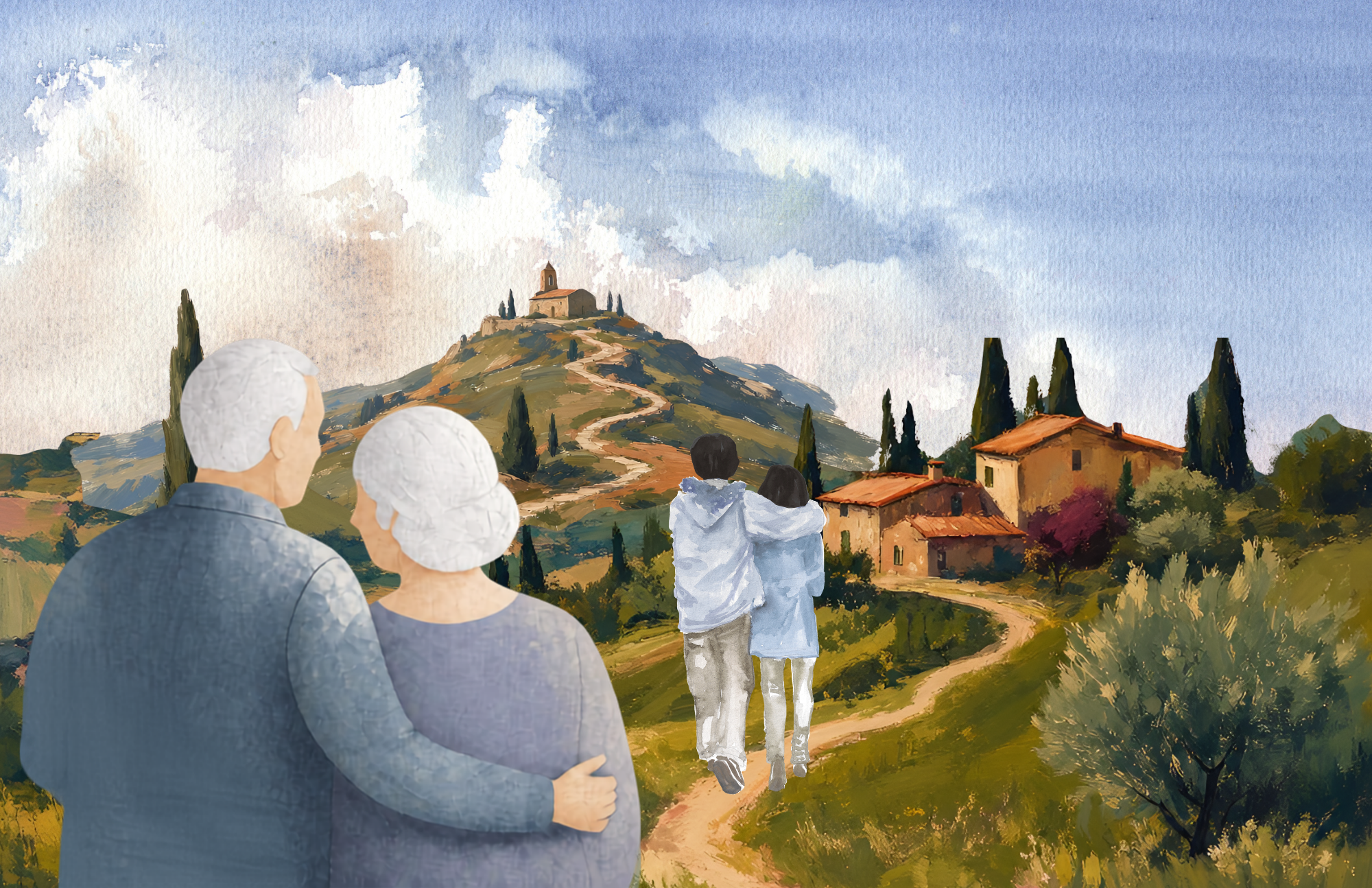
But she painted a picture of a man who had grown up in a valley in a small town in Italy. Whose home had been destroyed as a toddler by bombs dropped during World War II. Whose family had been transplanted to America, where they made a life for themselves with 3 kids, each 10 years apart. And later, he would joke that his parents could only bear to have sex every 10 years. She told me of a man who had built a wine business and traveled around Europe. Who had two children from a prior marriage. Who was hesitant to jump into a relationship with a woman who had two children of her own, but who fell in love anyways. Who had a beautiful life raising their four children, a gaggle of vastly different personalities. "One likes rock, one likes country, and one likes a little bit of everything." Who had a son that died 10 years prior. "You can't live very long if you have a problem with drugs," she told me.
She told me that he could fix anything. That he had remodeled their kitchen and designed a lift for use in hospitals, earning him a patent. Later, during his pinning ceremony, they couldn't open one of the doors to his room. The nurse leaned to the resident pulling at it and said, "it's broken, can ya fix it?" "He could," I thought.
Throughout it all, she was insistent that he would not have wanted to be intubated for more than just a short trial. She said, "Friday, come hell or high water, the tube is coming out." She told me she had talked with him that morning. She had told him that it was ok for him to go. That she and the kids and the grandchildren and the great-grandchild and the one on the way would be ok. And he had nodded. And she felt at peace with that.
I didn't think the tube would be ready by Friday. But to my surprise, come Thursday, it was time. He was mouthing something around the tube. "Help me?" "Kill me?" I'm not sure. But I had never seen a person beg with their eyes before. The tube came out. "Please, god, let me die." "Please let me go." She went to him. She leaned in close. She kissed his forehead, so tenderly and sweetly that I could feel the warmth from across the room. She called him baby. It's a strange thing, watching a 77-year-old man being cradled and called baby. It transports you to a time when they were young and freshly in love and slow dancing in the garage and you realize that some things never really go away. Sometimes the love takes root and sprouts and grows into a big oak tree but the roots are just the same as they were when the tree was a sapling.
He told her how much he loved her and the kids. But that it was time for him to go. And she said that it was ok, he could go. "We had a good run, huh kid?" she whispered to him. "You are unforgettable," he whispered back to her.
There are moments that feel sacred. When you cling to every detail, worried it will fly away if you lift a single finger. When you stand there and you feel every single word so deeply that you know there must be such a thing as a soul. When you catch a glimpse of what really matters. Of the love between two people that will last long after his heart thuds to a halt and his breath leaves his lungs. In those moments, you hope and you pray that when it's your turn, there is someone with lines etched deep into their face, calling you baby, stroking your head, and telling you that it's ok, that you can go.
Author: Madison Caldwell
Bio: Madison Caldwell is a third-year medical student at the University of Michigan. She is a strong advocate in the power of reflection, and she uses writing as a tool to cope with the amazing, beautiful, heartbreaking, and difficult moments of medical education. As a proud members of the Auxocardia team, she is excited to contribute her own work to the journal.
Commentary: This piece is my meditation on an encounter with a patient nearing the end of his life. While caring for him, I bore witness to multiple profound moments of true connection amongst family members. In this essay, I reflect on the fragments of this man's life that were shared with me through his wife's words. I explore the tenderness and love through which his family exhibited to him in his final days, reflecting a powerful alignment of his expressed wishes and his family's willingness to honor them. This patient challenged me to reconsider my own notions of the dying experience, reframing it as one centered in humanity and compassion.